06 July 2026

The Shanghai Accord and other somewhat secret monetary agreements

In 1989, the Asia-Pacific Economic Cooperation forum was established in Shanghai, China. The founding of this organization is sometimes referred to as the Shanghai Accord; see below¹ for further details about APEC. (Referring to APEC as a Shanghai Accord is a misnomer, and quite confusing, as will be explained.) 

Also, please be aware that APEC has no affiliation with AIPAC despite the similar acronyms! 

In 2016, there was talk of a Shanghai Accord, one that had less to do with APEC and much more to do with the Plaza Accord. 

First, let's go back in time a bit, to 1985.

Weakening the U.S. dollar then...

The Plaza Accord is a 1985 agreement signed by then-U.S. Treasury Secretary James Baker and the finance ministers of pre-unification West Germany, Japan, France, the UK and the other G8 countries. The intent was to guide the U.S. dollar lower versus the Japanese yen and German mark.

The Plaza Accord was motivated by the U.S. dollar's sharp appreciation with respect to other countries' currencies. It was put in place in order to jump-start growth globally while easing the U.S. current-account deficit. This would be accomplished by weakening the U.S. dollar and making U.S.-manufactured goods and services more globally price competitive.

1985 was the era of GATT (PDF "restricted document). The World Trade Organization (WTO) was still in the future (1995). China did not achieve most-preferred trading status in the WTO for another 15 years.

...and now?

Since 2010, the Bank of China (China's central bank) had been under pressure to allow the Chinese yuan to transition to a floating currency. The yuan remained a pegged currency in 2015.

Due to the prominence of China's production output (and maybe other reasons?) the International Monetary Fund (IMF) included the yuan in its basket of global reserve currencies as of 2015 onward. See Special Drawing Rights which explains the underlying concept of "global reserve currencies" plural. The IMF assumed that Chinese monetary policy would soon become more consistent with that of a free market, rather than a centrally-planned economy.

China Dream

The IMF was wrong.  The yuan continued weakening against the US dollar. China remained "socialist with Chinese characteristics" which, according to the Chinese Communist Party, is synonymous with the Chinese Dream. In 2013, a related slogan was "aircraft carrier dream".

China Dream depiction in northern China
"China Dream Shines Out" in city of Changchun formerly
the capital of Manchuria and now the capital of the Chinese
automotive industry; photo credit Wikimedia Commons

Mercantilism, protectionism, fixed-rate currency, and state-sponsored enterprise are also components of the Chinese dream. A transition from investment to consumption for the Chinese people has not happened, despite former UK Prime Minister George Osborne's rosy prediction in 2013. Instead, there has been a convergence of market economy values and state nationalism. The great rejuvenation of the Chinese nation is a metaphor for the "great rejuvenation of the Chinese race".

Fear at the time (2016) was that further Chinese central bank actions to sharply depreciate the yuan (thus making Chinese goods relatively cheaper for export) would send the trade-weighted dollar sharply higher, perhaps even into hyperstrong terrain not seen since 1981 to 1984.

How to inspire household animal spirits

This article in the Wall Street Journal's MarketWatch publication, To stave off currency war, is it time for a coordinated response to the Chinese yuan? conjectured that another accord might secretly take place at the G-20 meeting of central bankers in February 2016, in Shanghai. Instead of paraphrasing, I'll include an excerpt.

16 September 2025

Is the United States moving nuclear weapons to the United Kingdom?

Preface

I wrote this in late September 2023, and updated it on 27 January 2024. The questioner likely was motivated by the Russia - Ukraine war. Um Russian Special Military Operation? Invasion of Ukraine by Russia? You get the idea.

Has the U.S. recently moved nuclear bombs to the UK?

No, the United States has not moved nuclear weapons to the UK. Well, not yet and even if we eventually do, not for awhile. More on that in a moment. First, a bit about why it might not even be necessary.

The UK already has nuclear weapons

England developed nuclear bombs in 1953, and has been able to deliver them on submarines since 1969. That is to say, the UK can deliver (launch?) nuclear weapons from its nuclear-powered submarines. According to the sometimes lefty or maybe just contrarian Bulletin of the Atomic Scientists (the cheery people with the Doomsday Clock), 120 of the UK’s stockpile of 225 nuclear warheads are operationally available as of 2024.

UK as nuclear monad?

No, I'm not referring to monads in Haskell, nor in APL!

The UK is the only “nuclear weapons state” which has a single nuclear platform: Four Vanguard-class nuclear-powered ballistic missile submarines (SSBNs). To be precise, the SSBNs are the nuclear platform and the submarine-launched ballistic missiles (SLBMs) are the nuclear delivery system.

The UK limits its SSBNs to carrying no more than 40 nuclear warheads at a time. Prior to 2010, each submarine carried 48 nuclear warheads. The reduction from 48 to 40 was probably a strategic decision rather than a tactical one, i.e. there is still room for the extra warheads.

The nuclear warheads are named Holbrook. All 120 have the same name. More on that in a moment too.

Only one of the four submarines is at sea at any time. Two stay in port, while a fourth undergoes routine maintenance and repairs. This is why it makes sense to have 120 operational warheads (SLBMs): 40 go with the one submarine at sea. 40 remain on each of the two submarines anchored at dock but ready to be deployed if needed. Since the fourth submarine is undergoing maintenance, it wouldn’t do to have nuclear warheads on board! So, 40 x 3 = 120

Nuclear triad

In contrast to the UK, the US has a nuclear triad. That means that the US can dispatch nuclear warheads in three different ways: by Polaris submarine, by airplane, and by land.

“Land” doesn’t mean putting a nuclear bomb on a flatbed truck and just driving it up to wherever needs to be bombed, shoving it over the side, then driving away and detonating remotely from a safe distance. Instead, nuclear-tipped ICBMs (intercontinental ballistic missiles) get the nukes where they need to go. ICBMs are launched from one continent, travel quite low, though always above ground, to hit a target on another continent. ICBMs can be conventional too, i.e. they can ferry non-nuclear (conventional) bombs to their destinations. There are a few genuine and many CGI videos of ICBMs in action (most are courtesy of defense contractors). All depictions are impressive.

ICBMs are distinctly different from nuclear bomb delivery by airplane. In the latter case, the planes are flown to the destination, then the nuclear missiles are dropped from a height and detonate slightly above their targets.

US nukes in the UK


people standing in green grass in UK holding signs
CNDUK No US Nukes Day of Action demonstrators

09 August 2025

What happens if a supercomputer is used to mine bitcoins?

This has happened. I wrote about incidents of supercomputers being used to mine cryptocurrency a few years ago: Subverting computing research for fool's gold.

Bitcoin

NSF sponsored-researcher misused supercomputers to mine bitcoin via BBC June 2014:

A researcher has been suspended from a US national agency for misusing supercomputers to mine bitcoins at two universities. In a report, the National Science Foundation (NSF) revealed that more than $8,000 worth of bitcoins had been generated from NSF-funded computers... It is claimed that the unnamed researcher used remote access software and may have been attempting to cover his tracks.

So, he knew it wrong, tried to hide what he did including remotely accessing the supercomputer from Europe, and got caught.


The researcher’s access to all NSF-funded supercomputer resources was terminated, and after the NSF Office of Inspector General investigated (pp. 30-31), he was suspended from any further activities government-wide.

02 September 2024

Was the Turkic Khazarian empire the only non-Semitic Jewish nation?

Khazaria was NOT a Jewish nation! Given that fact, Turkic Khazaria couldn't have been a non-Semitic Jewish nation.

The idea first got widespread attention from Arthur Koestler's book, "The Thirteenth Tribe" in 1970-something, it has persisted. 

Many current proponents find such an explanation for Jewish ancestry to be a politically expedient justification for redrawing territorial boundaries in the Levant. Others, including some Jews, find the Khazar-origins idea to be interesting and compelling because, well, it is!

The Jews-as-Khazars idea has been thoroughly debunked by modern genetics:

Plausible at the time, the Khazar-origin premise has crumbled under the onslaught of modern molecular genetics. The latest volley: a study published this week in Nature Communications. The study’s senior author...[uses] high-resolution techniques that have highlighted the historical hopscotch of other migratory peoples... The authors analyzed the Y chromosome – a piece of the human genome invariably handed down father-to-son – of a set of Ashkenazi men ...

If Ashkenazi Jews were the progeny of Khazar royals, their DNA would show it.


The same Y chromosomal signature was found in every one of a large sample of Ashkenazi Jews, and quite a few non-Ashkenazi Jews. However, it was not present in the Y chromosomes of modern European non-Jewish men, nor in male inhabitants of what was once Khazaria.

04 January 2024

What do people mean when they say "this is why we can't have nice things"?

“This is why we can’t have nice things” is an idiom. It connotes a more complex layer of meaning since its origin. Here’s a good definition: A phrase used to blame someone or some group for engaging in the kind of behavior that has led to something valued becoming damaged, ruined, or corrupted.

In a 21st century context, it means this:

… it voices the earnest class aspiration of a dupe who believes that "things" are "nice" (a humorously innocuous word) based on some standard class grid. Then anything that goes wrong points to the larger (comic) frustration of not being able to achieve the standard class-inflected goal. Like Ralph Kramden or Lucy in I Love Lucy. 

The decontextualization of the phrase makes the writer or speaker (not the character) and the audience in cahoots against the position of class dupe.

What's it like to be a member of an Ivy League university's secret society?

If sworn to secrecy, such individuals are unlikely to answer, even as Anon on Quora.

We know that some of these societies exist e.g. Skull & Bones. My father was at Yale in the 1940s and told me that it existed, not that he knew more about it than someone who never went to school there. 

I went to Wharton, 50 years later. University of Pennsylvania is an Ivy League school but generally considered a lesser one. There was a rumor, never anything documented that I ever read, of a secret society for the 2nd year MBA's. 

It worked in the usual way: A fixed number of students, maybe 15 or 16, were asked to join each year. They were the "power elite" of Wharton Business School, and passed their spot on to successors upon graduation, but remained affiliated throughout their working lives. Only men were members, in keeping with tradition. I forgot the name of it, don't know if it even existed, or was just something UPenn students made up, so they would have a secret society of their own, like the other Ivy League schools!

Who is Sidney Blumenthal and why was Hillary Clinton contacting him via private email?

Sidney Blumenthal is the father of Max Blumenthal. Max is not a fan of Israel. It is peculiar how Sidney is such a neoliberal Hillary fan yet so defensive of Max. Clinton Adviser Sid Blumenthal's New Cause: His Son's Anti-Israel Book (2013):

A veteran confidant of Hillary Clinton has waded into a bitter argument over the explosive topic of Israel, defending his son’s intensely anti-Israel book from a liberal critic. 

Sidney Blumenthal, a former New Yorker writer turned Clinton adviser from the White House to the 2008 campaign, has been waging an online campaign against Nation columnist Eric Alterman for negatively reviewing his son Max Blumenthal’s book, Goliath. The book was described by Alterman, himself a frequent critic of Israel, as “awful” and something that “could have been published by the Hamas Book-of-the-Month Club (if it existed).”

Clinton Foundation officials refused to respond to questions of whether the elder Blumenthal is currently on a Clinton payroll.

Sidney contacted Hillary by private e-mail during the her destabilization of Libya because he had various business ideas, for himself, and wanted her feedback and insights. He stopped after the U.S. ambassador was killed at the consulate in Benghazi. Hillary thought Sidney was very insightful, and had been forwarding excerpts from his emails to her staff and friends for years. 

Sidney Blumenthal's Mosaic Mugshot by Kevin Vaughn, on Flickr

19 December 2023

Are clothes the root of all evil?

How would today be different if humans rejected clothing and nudism prevailed?

Let's start by turning to Biblical scripture for help in answering the question. In Genesis, Adam and Eve ate an apple, i.e. fruit of the Tree of Knowledge, despite it being forbidden. (Blame the serpent.) Upon doing so, they felt shame at their nakedness, and covered themselves. In fact, that is how God immediately knew that Adam and Eve had eaten of the Tree of Knowledge.

naked = without wisdom gained from eating of Tree of Knowledge 

clothed = with wisdom gained from eating of Tree of Knowledge

evil = serpent

Adam and Eve in the Garden of Eden
Adam and Eve each hold a golden apple.
Elisha of Ascoli's Ketubah: Mantua, Italy on 31 August 1629

Since this was a decoration for the upper right corner of a ketubah (a marriage certificate used mostly by Sephardic Jews from about 1400 to the 1950s), the Hebrew inscription (happily!) doesn't directly correspond with the image.

23 November 2023

Many happy returns!

This is birthday girl


Deluxe version


Large, somewhat grainy animated GIF with music 


Днем Рождения! Happy Birthday! 


05 August 2023

Demise of the Navajo Generating Station

Here's the Quora question: How can California go completely to electric cars when we already experience brown-outs and other rolling blackouts due to not having enough electricity?

This answer by Quora user Edw says it all.
California is decommissioning its nuclear plants. Wind and solar won't be able to take up the slack so it will have to buy power from nuclear and coal plants in neighboring states.

That might not be as easy as it once was. More on that in a moment. I upvoted the answer and left a comment of agreement.

Yes, you are correct. California has been sucking all the electricity from Hoover Dam for decades. The Colorado River and Hoover Dam are on the border between Arizona (where I live) and Nevada. Yet my state only gets 10% of the electricity generated by the hydroelectric power from Hoover Dam. Nevada gets about the same. California takes over 50%.

There's more. Californian insanity has spread like a contagion to states north and east of California, and now they are decommissioning their nuclear power and coal plants too!

Let me tell you about another victim, not a nuclear plant, but important nonetheless

The Navajo Generating Station

The Navajo Nation operated a coal power plant on reservation land for DECADES. They were forced to shut it down in 2019. Green liberal Democrats and Republican renewable energy business didn’t care that the Navajo Generating Station had kept the reservation energy-independent. It is a tragedy how 700 Navajo people lost their good jobs, that were right there, on the reservation in northeast Arizona. The generating station produced more energy than needed locally, so the extra was sold through interties to the electric power grid. AND the coal was mined locally!

The Navajo nation protested regulatory demands for plant closure, instigated by California, to no avail. Although it was located on supposedly sovereign native American land, The State shut down their power plant. There is nothing to replace it. 

Google Maps retrospective

I was curious, and had a look at what Google Maps reviews had to say about the Navajo Generating Station, which was run with assistance from a Maricopa County public utility, the Salt River Project. I reproduced some of the reviews here. 

Wind and solar will never replace nuclear and coal, despite what John Kerry and other attendees at COP say. This first review describes solar only advocates as ignorami.

This guy HATED the Navajo Generating Station, as it detracted from his Lake Powell experience, OMG!

04 January 2023

Why is working in pairs so rare at work?

I agree that on-the-job working in pairs is rare. There are some exceptions such as pair programming and law enforcement (police work in pairs usually) but not many others!

Why are pairs so rare?

I attribute it to the fact that some supervisors and project managers either:

  1. don’t know what is technically involved in enough detail to think of a way to allocate work to teams of two. When they do, it usually isn’t two workers who are peers. Instead, one is experienced and the other is less so or maybe new to the company or project, and mostly “shadows” the experienced person. It is more like one person working, and the other person watching and learning!
  2. are concerned that two people who are peers—and should contribute equally—will not. One person will do most or all of the work. Why does this happen, and why doesn’t the one who contributes say something about it to management or the team leader? Lots of reasons, some of which I couldn’t ever figure out! Even when I suspected this was going on, it wasn’t possible to prove without the cooperation of the person who was doing the bulk of the work.

People can work in pairs most effectively when there are not multiple dependencies in the workflow/ timing. For example, one person might write the code to do some analysis, after or maybe simultaneously with the other person who looks for a data source then tests/confirms its adequacy (e.g. quality, frequency, time span, availability/cost, has a data dictionary) for the analysis. Yet even this scenario is more accurately described as two people working on two different parts of a project (or assignment, or experiment) rather than working as a pair.

An eponymous example

The only example that quickly comes to my mind is pairs programming. I did that at work, briefly. It was fascinating and revealing!

02 December 2021

What do Nick Szabo and Wei Dai do for a living?

What do secretive cryptography experts like Nick Szabo and Wei Dai do to earn a living? via Quora

Now with 2024 update

The most transparent cryptography experts are those that work in academia. Matthew D. Green is a professor of computer science at Johns Hopkins University. Others work in industry and have prominent public profiles like Bruce Schneier (British Telecom) and Burt Kaliski (Verisign now RSA). Craig Gentry works for IBM; he developed fully homomorphic encryption about 10 years ago.

Some cryptographers have sub rosa personal lives, yet maintain updated websites including disclosure of who and where they have worked in the recent and less-recent past. Their websites aren't just blogs. They have plenty of well-organized content. Good examples are the steganography guys, Neil F. Johnson and Gary Kessler, who work as consultants and sometimes as longer-term contractors.

Nick Szabo is very cryptic!

It isn't easy to discern what Nick did or does for a living, or anything else about him, even with with pro-level google-fu! Nick Szabo has an undergraduate degree in computer science from the University of Washington in Seattle and a professional degree in the law (Juris Doctor, which is different than a PhD in law) from George Washington University. In the United States, a law degree is a three-year program of study. In one of Nick Szabo's Unenumerated blog posts, he acknowledged being a law school student in 2006. Let's assume he graduated in 2008.

Given his law degree, I would suggest checking to see if Nick is a member of the bar in any state. He may not be, as plenty of people with law degrees don't practice law although they use their knowledge of it in their work, and are often hired because of it. Examples include legal departments of financial services firms (both fintech and traditional), manufacturing companies, and healthcare of all sorts.

If one were to want to develop a digital currency, a high level of competency in computer science as well as a law degree seem ideal, although some knowledge of economics would help too. Many patent attorneys have similar backgrounds, e.g. a physics or electrical engineering undergraduate degree, three years or more of working in the field, then law school.

04 October 2016

Will the civil war in Syria begin a second Cold War?

One of the pre-conditions for the Cold War was the existence of nuclear weapons, and the knowledge of mutually assured destruction. Another of the pre-conditions for the Cold War was the resolute leadership (and populace) of the opposing post-World War 2 powers, the USSR and the USA.

In other words, the awareness of each other's nuclear capability acted as deterrent to outright hostilities, while each nation's depth of commitment to its political and social ideology meant that withdrawal or capitulation was not an option.

Is Syria the first proxy war of Cold War 2.0?

No, not really.

Nuclear weapons remain a potent deterrent, now and prior to 1991. Russia has replaced the USSR as one of the two powers, with greater strength than the USSR in some ways (no longer socialist, religiously tolerant), but less in others (equally or more authoritarian leader, loss of Soviet bloc nations in eastern Europe and central Asia). Russia certainly has resolute leadership. A cold war requires two antipodal powers though.

The USA's presidential leadership under the Obama administration is weaker than that of any president during the Cold War years. Putin is described in many unflattering ways--as a thug and a former KGB agent--but never as effete. Russia's Foreign Minister Sergey Lavrov is intelligent and perceptive. He is a formidable counterpart to our recent secretaries of state, John Kerry and Hillary Clinton.

The Syrian Civil War and containment of ISIS cannot be a US versus Russia proxy war if US foreign policy is indecisive, slow-moving, and undermined by the belief that Russia's need to retain its sphere of influence (even though primarily for its own domestic security) is "on the wrong side of history" thus should be ignored.

drawing of Marie Harf
Artistic rendering of Marie Harf

Another example of the Obama State Department cluelessness is provided by US State Department spokesperson Marie Harf: She said that unemployment was a primary motivation for the formation of ISIS. 

I found the not-so-nice drawing of her above.

Had a good job, still committed jihad

The BBC could not have phrased it better in this 19 February 2015 article, #BBC Trending: No jobs causes jihad

US State Department Deputy Spokesperson Marie Harf, has been ridiculed for her comments about fighting Islamic State through employment... Harf told MSNBC that... jobs and opportunity would dissuade people from joining - and thus prevent terrorism.

The notion was met with derision by conservatives, and has led to a flood of online memes. Everything from mock hashtags like #jobsforISIS to pictures of known terrorists like Nidal Hassan, the Fort Hood shooter, with captions like "had a good job, still committed jihad" to personal attacks against Harf herself, making jokes about her age, appearance and intellect.

04 February 2016

A Populist Coalition: GOP ethnic minority voters support Trump

Why are minorities telling pollsters they support establishment status quo candidates in 2016? This was my answer on Quora.

Minorities are enthusiastic supporters of some very non-establishment candidates.

Donald Trump counts among his supporters more black and Hispanic people than ANY other Republican presidential candidate, see Donald Trump’s Strongest Supporters: A Certain Kind of Democrat via The New York Times and Trump winning over Latino Republicans, poll says via NY Post.

Recent surveys found that Muslim Republicans are supportive of Trump too, more so than all other Republican presidential candidates combined! Not many Muslims support Republicans, but those who do support Trump; CAIR did the study. If you don't like that link from Vox, here's one from Voice of America: Why Some US Muslims Still Plan to Vote for Donald Trump.

Minorities are often silenced in America

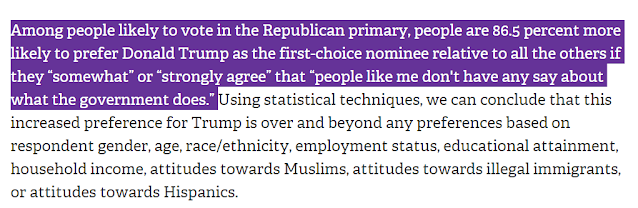
The RAND Corporation's 2016 election survey panel is notable for being longitudinal rather than cross-sectional. It shows that one particular non-establishment candidate is more popular among those who feel they have no say in government. This is true for that one candidate, more so than any other,  whether Republican or Democrat. 

See more here, RAND Kicks Off 2016 Presidential Election Panel Survey in the section titled, "Trump's Populist Coalition".


Political support given to 2016 presidential electoral candidates
U.S. Presidential Election 2016: "People like me don't have any say..."


If one had a flair for the dramatic, one could say that the RAND Corporation has proven that support for Donald Trump transcends voters' gender, age, race/ethnicity, social status, and attitudes towards the disadvantaged.

screenshot of text from RAND study

03 December 2015

R to SAS bait and switch?

How would you handle a scenario where the company may have altered the truth about a job?

Question details

"So here is a scenario. I accepted a job two months ago as an analyst where I'd be working primarily with two programming languages. Of the two, one I'm proficient in (R) and the other was brand new to me (SAS). I was going to be their in-house R expert. However, soon after starting, they said that I needed to focus just on SAS. 

Learning SAS isn't that hard and I can spend my evenings using R, however, that is not the arrangement that we agreed on. Therefore, I'm a little frustrated by this and considering whether I should jump ship. What would you do? 

For what it's worth, I've had a couple companies who I've talked with in the past reconnect with me and one even offered me a data scientist role. So I have something lined up if I want to jump ship." 

My answer

10 November 2015

Too much cheap money and distorted market valuations

As of November 2015, what does "Finally, too much cheap money lets companies operate with bad unit economics and cover up all sorts of internal problems" mean in the case of distorted valuations? How does this make a startup less robust in the future?"

Let me tell you all about it! 

Interest rates are being held at zero by the Federal Reserve, using quantitative easing, in order to protect the economy from recession. Unfortunately, this has been necessary since 2008, and the Federal Reserve is continuing to postpone raising rates, i.e. monetary normalization, although it is increasingly difficult to justify.

...the entire public market is likely to go down—perhaps substantially—when interest rates materially move up, though that may be a long time away.

The Federal Reserve intended to keep interest rates low, in order to encourage businesses to invest in R&D, new ventures or make capital expenditures for plants, property, and equipment. The logic is that with interest rates so low, there is a strong disincentive to accumulate cash reserves, for both businesses and investors. For reasons that aren't entirely clear, businesses have not taken advantage of the ultra-low interest rate environment (the cheap money in your question) for building durable wealth, but instead, have been doing things like stock buybacks.

This recovery has been one of the weakest in U.S. economic history, and cannot seem to get past stagnant wages and persistently high unemployment.

In a world of 0 percent interest rates, people become pretty focused on finding new sources for fixed income.

Investors are chasing yield, which only drives speculative markets higher. Speculative markets include the stock market as well as venture capital. There are fewer sources of return on investment, despite easy credit for businesses due to extravagantly accommodating monetary policy.

21 October 2015

Edward Snowden, Facebook, and maybe Quora

What does Edward Snowden think of Quora? Edward Snowden probably hasn't even heard of Quora! Most people haven't. It would be much more unlikely for him to not have heard of Facebook. 

Snowden's comment about Facebook doesn't reflect in any way on whether he has an opinion of Quora, or if he did, whether his opinion about Facebook would have any relevancy to what he thought of Quora. Facebook and Quora have founders (Adam D'Angelo) in common, but little else. Quora is a closely-held private company, with unknown revenue sources and no transparency policy.

Facebook is a free service like Quora, but Facebook makes extensive use of advertising in order to generate revenue. Facebook also generates revenue through other means, using its repository of user-contributed data. In contrast, Quora does not display any (overtly) user-targeted advertising. Facebook common equity is publicly traded on listed stock exchanges following its IPO in 2012. 

Given widespread knowledge of Facebook's business model, past privacy controversies covered in the press, and its relative transparency as a public company, I am surprised that Snowden would expect Facebook to make any sort of "commitment to the user". 

Facebook users pay nothing to use Facebook. Instead, and this is a cliche by now yet accurate, users ARE Facebook's product! Edward Snowden said this about Facebook:
They need to decide who they work for: the government or the people who use their services.
Users are not Facebook's customers. Facebook works for the businesses and organizations who pay for its services.


Does Facebook work for one or more governments in some capacity? 

Snowden suggests this in his comment. The answer is probably yes, although payment might be quid pro quo as well as cash. 

Facebook primarily works for the corporations and businesses that pay for user-targeted advertising on Facebook's platform. Edward Snowden, much like Glenn Greenwald, rarely portrays corporate invasion of privacy as a concern, preferring to focus on governments instead.

03 October 2015

Buy and hold and hold and hold

If you were allowed only to buy only 1 stock + put options for downside protection in that stock and be forced to hold it for at least 1 year from now what stock would you consider buying to achieve the best returns? 

I would never set up a trade like that with any stock. Being long put options for an entire year is crazy. In order to realize any positive return, you would need to make a profit on the stock that was greater than the premium you paid for the put option, plus any commissions and fees you incurred. US stock options expiry is monthly, so you would also have the inconvenience of remembering to roll over the put option, 12 times!

Instead of buying put options as insurance, I would buy stock and sell call options, with appropriately chosen strikes depending on the stock price each month. That must be followed very closely too, due to the potential negative upside exposure if neglected. 

If your intent is to buy and hold one stock, for an entire year, you are making a decision based on something that is driven by fundamentals of the company.  In that scenario, stay away from options. Buy a small cap company, of the sort that Mario Gabelli picks for his small cap growth fund (GABSX), see Mario Gabelli makes big bucks bucking trends

If you don't like that, do your research and find a company with publicly traded stock that is NOT on the Pink Sheets and is undervalued, or has a high likelihood of growth, or the expectation of a massive one-time dividend (I'm thinking of Apple, just as an example) due to accounting or regulatory circumstances.

27 September 2015

Is the present European Refugee Crisis comparable to flight from the Axis during WWII?

How does the present response to the European Refugee Crisis compare to the response to those fleeing Axis regimes in WWII? The comparison is of two very different situations. Think in terms of who was fleeing what.
 

Axis regimes during World War 2

Who: Well-educated, poor, middle and upper class Europeans who were fluent in one or more western languages; many were highly skilled professionals, academics or tradesmen. Many were wealthy.[1] Most were Jewish or Roman Catholic. Demographically, they were men, women, children and the elderly. 

What: Flight from the most highly developed nation in the world, Germany, then radiating outward to include flight from Italy, France, The Netherlands, Scandinavia, Poland and Eastern Europe to anywhere that would take them. Refugees gladly adopted the customs and social norms of those few countries that gave safe harbor.

02 August 2015

Are user groups dead?

User groups are not dead... yet.

Be aware that user group can refer to either online or IRL (in real life) gatherings. Erica Friedman is not optimistic about Internet user groups:

My gut feeling is that user groups are mostly old technology (Usenet, Forums) and the only people on them are the deeply dedicated/sticking to the old school ways, while the interesting conversations have moved off into newer forms of communication.

They will die out when the last Listserv server or Usenet group dies, but in the meantime they will linger on in corners of the Internet as they have for many years now.

Those are online forums, mostly consisting of Usenet and Yahoo Groups. Both Usenet and Yahoo Groups continue to exist, if not exactly thrive. Usenet user groups have a characteristic tone and format which has not changed since inception. For example, I was just reading this thread, A moderated forum: inconsistent with my Liberal principles from rec.music.classical.recordings (now hosted by Google Groups),
So you think I am those other guys. What, is your brain made of chav?
--Borscht Belt
Incongruous, isn't it? Very typical too!